Employee Onboarding Process: A Practical Offer-to-Confirmation Blueprint
Introduction
Hiring a candidate is only the beginning of a successful employment relationship. The next challenge is helping that person become a confident, productive and well-integrated employee.
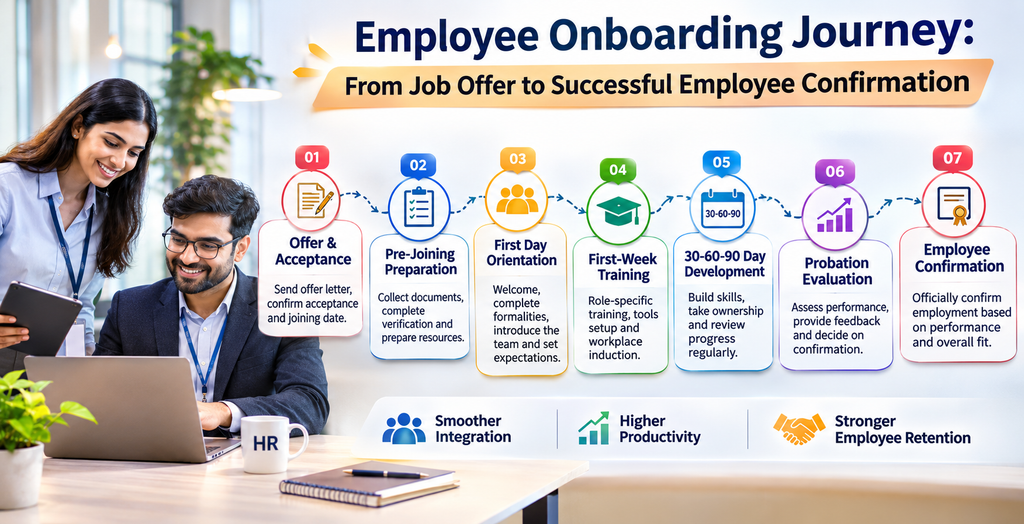
A structured employee onboarding process connects every stage of hiring. It begins when a candidate accepts an offer and continues through joining formalities, workplace orientation, role-specific training, performance reviews and employment confirmation.
Without a clear process, HR teams can miss important documents, managers may fail to explain expectations, and new employees may struggle to understand their responsibilities.
This guide explains how to manage the complete employee journey, from the offer letter to final confirmation.
1. What Is the Employee Onboarding Process?
Employee onboarding is the structured process of welcoming a new employee and preparing them for their role.
It includes administrative tasks, documentation, workplace orientation, training, team introductions, performance expectations and regular feedback.
The process usually starts after the candidate accepts the employment offer.
A complete onboarding process generally includes:
- Offer acceptance and employment documentation.
- Pre-joining preparation.
- First-day orientation.
- First-week training.
- 30-, 60- and 90-day performance reviews.
- Probation assessment.
- Employment confirmation.
2. Why a Structured Onboarding Process Matters
A new employee needs more than an appointment letter and a desk. They need to understand the organization, their responsibilities, workplace policies and the people who can help them.
A structured process provides several benefits:
- Clear job expectations.
- Faster workplace adjustment.
- Better communication.
- Fewer administrative mistakes.
- Consistent employee experience.
- Better performance management.
3. Stage One: Offer Letter and Acceptance
The onboarding journey begins when the organization selects a candidate and prepares an employment offer.
Important details in an offer letter
| Information | What HR should include |
|---|---|
| Employee name | Candidate’s full legal name |
| Job title | Official designation |
| Department | Assigned department |
| Reporting manager | Name or position of supervisor |
| Employment type | Permanent, fixed-term or other applicable type |
| Joining date | Confirmed start date |
| Work location | Office, hybrid or remote |
| Salary | Agreed compensation structure |
| Working hours | Expected schedule |
| Probation | Duration and applicable conditions |
| Notice period | Applicable notice requirements |
Offer acceptance workflow
- HR prepares the offer letter.
- The authorized person reviews and approves it.
- HR sends the offer to the candidate.
- The candidate reviews the employment terms.
- The candidate accepts or requests clarification.
- HR receives the signed acceptance.
- HR records the acceptance and joining date.
HR checklist
- Verify the candidate’s name and designation.
- Confirm the approved salary.
- Check the reporting manager.
- Confirm the joining date.
- Include applicable employment terms.
- Obtain authorized approval.
- Send the offer letter.
- Collect signed acceptance.
- Update the recruitment tracker.
4. Stage Two: Pre-Joining Preparation
Pre-joining, also called preboarding, covers the activities between offer acceptance and the employee’s first working day.
4.1 Send a welcome email
The email should include:
- Employee’s joining date.
- Reporting time.
- Office address or remote meeting details.
- HR contact information.
- Reporting manager’s name.
- First-day schedule.
- Required documents.
4.2 Collect joining documents
Common examples include:
| Document | Purpose |
|---|---|
| PAN details | Tax and payroll administration |
| Identity and address proof | Identity verification |
| Bank account details | Salary processing |
| Educational certificates | Qualification verification, where relevant |
| Experience letter | Previous employment verification, where relevant |
| Signed employment documents | Employment records |
| Emergency contact | Workplace administration |
Collect only the information the organization genuinely needs. Restrict access to sensitive employee records.
4.3 Complete background verification
HR should define verification requirements, explain the process, obtain appropriate consent where required, review discrepancies fairly and record the outcome securely.
4.4 Prepare workplace resources
| Team | Responsibilities |
|---|---|
| HR | Employee record and joining documents |
| IT | Laptop, email account and system access |
| Administration | Workstation and access card |
| Manager | Role expectations and initial work plan |
| Buddy | Informal support and team introductions |
Pre-joining checklist
- Send welcome email.
- Confirm joining date.
- Collect required documents.
- Complete applicable verification.
- Prepare employment paperwork.
- Create employee record.
- Arrange laptop and equipment.
- Create authorized system accounts.
- Assign a buddy or mentor.
- Prepare the first-week schedule.
5. Stage Three: Employee’s First Working Day
The first working day creates an important first impression. HR should make the employee feel welcomed while ensuring that essential administrative tasks are completed.
Recommended first-day schedule
| Time | Activity | Responsible person |
|---|---|---|
| 9:30 AM | Welcome and attendance | HR |
| 10:00 AM | Joining documentation | HR |
| 10:45 AM | Company introduction | HR |
| 11:30 AM | Team introduction | Manager |
| 12:00 PM | Workplace or virtual tour | Buddy |
| 1:00 PM | Lunch break | — |
| 2:00 PM | Laptop and system setup | IT |
| 3:00 PM | Role discussion | Manager |
| 4:00 PM | First-week plan | Manager |
| 4:30 PM | Questions and feedback | HR |
Adjust these timings to suit the company’s working schedule.
6. Stage Four: First-Week Orientation and Training
The first week should help the employee understand how to perform their job.
Suggested first-week training plan
| Day | Training activity | Expected outcome |
|---|---|---|
| Day 1 | Company and team introduction | Understand the organization |
| Day 2 | Department structure and policies | Understand workplace processes |
| Day 3 | Job responsibilities and tools | Learn essential systems |
| Day 4 | Practical training and guided tasks | Apply basic knowledge |
| Day 5 | Review and feedback | Identify learning needs |
Managers should explain job responsibilities, reporting structure, communication channels, approval processes, quality expectations and performance indicators.
7. Stage Five: The 30-60-90-Day Onboarding Plan
A 30-60-90-day plan gives the employee clear learning and performance milestones.
First 30 Days: Learn and Understand
The first month should focus on learning.
Employee responsibilities:
- Understand company policies.
- Learn job responsibilities.
- Complete initial training.
- Understand team workflows.
- Learn essential tools.
- Complete small assigned tasks.
Manager responsibilities:
- Explain role expectations.
- Provide learning resources.
- Assign manageable tasks.
- Schedule regular meetings.
- Identify knowledge gaps.
Days 31–60: Apply and Improve
The second month should focus on practical work.
Employee responsibilities:
- Handle regular responsibilities.
- Complete assigned projects.
- Follow team processes.
- Improve task quality.
- Communicate progress.
Manager responsibilities:
- Review work quality.
- Monitor progress.
- Discuss challenges.
- Provide additional coaching.
Days 61–90: Demonstrate Role Readiness
The third month should focus on consistency and greater independence.
Employee responsibilities:
- Manage assigned work independently where appropriate.
- Meet agreed targets.
- Demonstrate role-specific knowledge.
- Collaborate with colleagues.
- Identify improvement opportunities.
Manager responsibilities:
- Evaluate performance against agreed expectations.
- Review completed work.
- Discuss strengths and development needs.
- Document feedback.
- Recommend appropriate next steps.
Example 30-60-90-day scorecard
| Performance area | Suggested weight |
|---|---|
| Job knowledge | 20% |
| Work quality | 25% |
| Productivity | 20% |
| Communication | 15% |
| Team collaboration | 10% |
| Attendance and policy compliance | 10% |
| Total | 100% |
This is an illustrative framework. Organizations should adjust it to each job.
8. Stage Six: Probation Review and Performance Evaluation
Probation gives the organization an opportunity to assess an employee’s suitability for the role.
HR should evaluate:
- Job performance.
- Work quality.
- Productivity.
- Communication.
- Teamwork.
- Relevant policy compliance.
Probation review workflow
- HR checks the probation end date.
- HR requests feedback from the reporting manager.
- The manager reviews documented performance.
- HR checks applicable training and documentation.
- The employee receives feedback.
- The organization decides the appropriate next step.
- HR communicates the decision in writing.
Possible outcomes include successful completion, an extension where permitted and justified, or another action permitted by the employment terms and applicable law.
Managers should discuss performance concerns early rather than waiting until the final day.
9. Stage Seven: Employee Confirmation Process
Employee confirmation is the formal communication that an employee has successfully completed the applicable probation requirements and will continue under the relevant employment terms.
Confirmation process
- Check the probation period.
- Collect manager feedback.
- Review performance.
- Check outstanding requirements.
- Obtain required approval.
- Prepare the confirmation letter.
- Communicate the decision.
- Update employee records.
Confirmation letter checklist
- Employee’s full name.
- Employee ID.
- Designation.
- Department.
- Reporting manager.
- Probation completion status.
- Effective confirmation date.
- Applicable employment terms.
- Authorized signature.
- Copy saved in the employee record.
Probation and confirmation rules can vary by jurisdiction, industry, employee category, applicable standing orders and employment contract. Obtain appropriate HR or legal review.
10. Roles and Responsibilities During Onboarding
| Stakeholder | Main responsibility |
|---|---|
| HR team | Documentation and onboarding coordination |
| Recruiter | Offer acceptance and joining coordination |
| Reporting manager | Job expectations and performance review |
| IT team | Equipment and system access |
| Administration | Workplace arrangements |
| Buddy or mentor | Everyday guidance |
| New employee | Documentation, learning and agreed responsibilities |
| Senior management | Policy approval and required decisions |
11. Common Employee Onboarding Mistakes
Sending incomplete offer letters
Use an approved offer template and review all important fields.
Delaying document collection
Share a clear joining checklist before the start date.
Not preparing IT equipment
Ask IT to prepare and test equipment before joining.
Providing no training plan
Prepare a role-specific first-week and 30-60-90-day plan.
Ignoring manager involvement
Make the reporting manager accountable for role orientation and feedback.
Conducting no probation reviews
Schedule review meetings before the probation deadline.
Delaying confirmation communication
Track probation dates and communicate decisions within the applicable process and timeline.
12. Employee Onboarding Checklist: Complete HR Reference
Offer and acceptance
- Prepare and approve offer letter.
- Send offer to candidate.
- Collect signed acceptance.
- Record agreed joining date.
Pre-joining
- Send welcome email.
- Collect required documents.
- Complete applicable verification.
- Prepare employment paperwork.
- Create employee record.
- Arrange equipment and access.
- Assign buddy or mentor.
First day
- Complete joining formalities.
- Introduce employee to team.
- Explain company policies.
- Set up laptop and accounts.
- Discuss job responsibilities.
- Share first-week schedule.
First week
- Complete role-specific orientation.
- Explain team workflows.
- Provide initial training.
- Assign first tasks.
- Conduct end-of-week check-in.
30-60-90 days
- Complete 30-day review.
- Complete 60-day review.
- Complete 90-day review.
- Document feedback and development needs.
Probation and confirmation
- Check probation end date.
- Collect manager assessment.
- Review agreed performance criteria.
- Obtain required approval.
- Communicate decision.
- Update employee records.
13. How HR Can Improve the Onboarding Process
Organizations can improve onboarding through practical methods:
Use a standard checklist: Create one approved checklist for each employee category or role.
Use an HRMS: Maintain employee details, joining dates, documents and review records in an authorized HR system.
Set automatic reminders: Remind HR and managers about joining dates, pending documents and upcoming reviews.
Create role-specific plans: Different jobs need different training.
Schedule regular feedback: Give employees opportunities to discuss problems and ask questions.
Review the onboarding system: Collect feedback from recent employees and managers.
Useful onboarding performance indicators
| Metric | What it measures |
|---|---|
| Joining documentation completion | Whether required paperwork is complete |
| First-day readiness | Whether equipment and access are available |
| Training completion | Whether required learning is complete |
| 30-60-90 review completion | Whether managers complete scheduled reviews |
| Time to role readiness | How long the employee takes to handle expected work |
| Probation decision completion | Whether the required review happens on time |
| New-hire feedback | Employee experience during onboarding |
14. Frequently Asked Questions
What are the main stages of employee onboarding?
The main stages are offer acceptance, preboarding, first-day orientation, first-week training, performance reviews, probation assessment and confirmation.
When should employee onboarding begin?
It should begin after the candidate accepts the offer.
How long should the onboarding process last?
The duration depends on the role. A 30-60-90-day plan is a useful starting framework.
What documents are required during employee onboarding?
Common examples include identity information, tax and payroll details, education or experience documents where relevant, signed employment documents and emergency contact information.
What is the difference between induction and onboarding?
Induction usually focuses on introducing the employee to the organization, policies and workplace. Onboarding is broader and includes preparation, training, performance support and integration.
Who is responsible for employee onboarding?
HR coordinates the overall process. Managers handle role-specific expectations and performance. IT and administration prepare resources.
What happens after probation?
The organization reviews performance and takes the appropriate action under the employment terms and applicable rules.
Is a confirmation letter necessary?
The requirement depends on applicable employment terms, policies, standing orders and laws. Written confirmation is a useful record.
How can companies improve their onboarding process?
Use clear responsibilities, standard checklists, prepared equipment, role-specific training, regular feedback and documented performance reviews.
15. Final Thoughts
Employee onboarding should be treated as a complete employment journey, not a one-day HR activity.
A well-planned process connects the offer letter, joining documentation, orientation, training, performance feedback and confirmation decision.
HR teams should coordinate each stage with managers, IT and other relevant departments.
Employees should understand what the organization expects and where they can get support.
The most effective onboarding systems combine clear documentation with regular communication and practical training.
When every stakeholder understands their responsibilities, the organization can create a more consistent and professional experience for new employees.
SEO Metadata
SEO Title: Employee Onboarding Process: From Job Offer to Confirmation
Meta Description: Learn how to manage employee onboarding from offer acceptance to joining, training, probation reviews, and final confirmation.